Description
Product Description
- Simple split-type calibration device;
- Quickly checks the parallelism deviation between the plane of experimental equipment and the workbench;
- Suitable for scenarios such as optical device construction and precision instrument debugging;
- Effectively improves the efficiency and accuracy of optical system debugging;
- Easy to operate, compact in size, and portable;
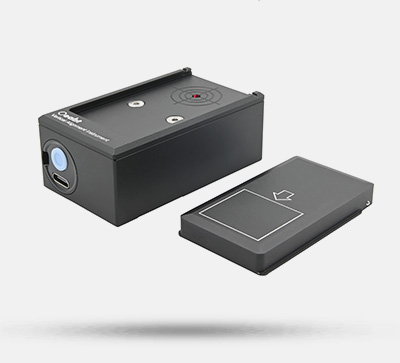
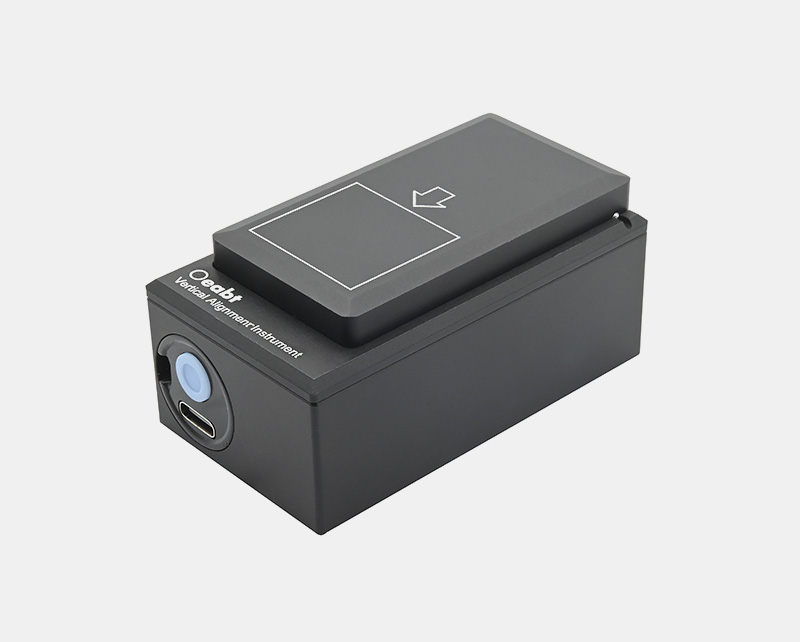
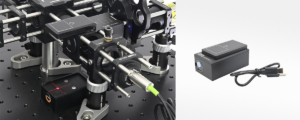
The VAI-01 is a simple split-type parallel calibration tool that adopts the laser reflection principle. It can quickly detect the parallelism deviation between the plane of motion control devices, optical experimental systems, precision instruments, etc., and the workbench, providing visual parallel adjustment error information.
| Model | VAI-01 |
| Specification | Calibration Host: 704027mm;Reflection Base Plate: 60336mm, Reflective Lens: 35257mm |
| Output Wavelength | 650nm (Class II) |
| Light Output Aperture | ∅3mm (±0.1mm) |
| Reticle Size | Circles: ∅8mm, ∅12mm, ∅18mm; Straight Lines: 21.9mm, 25mm |
| Reticle Accuracy Deviation | 1mm grid (at 200mm height), ≈1/3’ |
| Beam Vertical Deviation | ≈1/6’ (tested at a beam height of 2.5m) |
| Working Distance | 50-1000mm |
| Power Supply System | Lithium Battery (700mAh capacity) |
| Battery Life | Continuous operation ≥5h |
| Charging Interface | Type-C USB |
| Switch Gears | 4-speed button: 1st press (on), 2nd press (dim), 3rd press (flashing), 4th press (off) |
| Weight | 149.3g |
| Material | Aluminum Alloy + Reflective Mirror |
| Component List | Calibration Host (including dot laser module), Reflection Base Plate (mirror surface), USB Type-C charging cable |
Technical Description
(1) In optical systems, the construction and calibration of optomechanical components usually rely on the operator’s skills and experience, which is inefficient and cumbersome for debugging in limited spaces. The VAI-01 is a simple split-type parallel calibration tool that uses the laser reflection principle. It can quickly detect the parallelism deviation between the plane of motion control devices, optical experimental systems, precision instruments, etc., and the workbench, providing visual parallel adjustment error information.
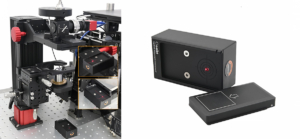
(2) The device consists of two parts: a calibration host (including a cross laser module) and a reflection base plate (mirror surface), with a Type-C USB charging cable included.
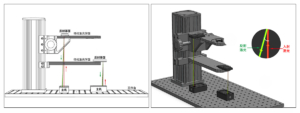
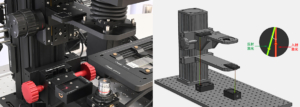
(3) During use, place the reflection base plate on the optical mounting surface to be calibrated (such as a lens holder, translation stage base, etc.), and place the calibration host at the corresponding position on the workbench. After turning on the laser, by observing the offset between the reflected light spot and the reticle, the user can real-time monitor the parallelism error and adjust the base according to the spot position to achieve precise calibration.
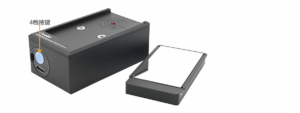
(4) Through the intuitive display of spot offset, the calibrator allows operators to quickly identify and correct any parallelism issues, greatly improving the efficiency and accuracy of optical system debugging with simple and easy operation.
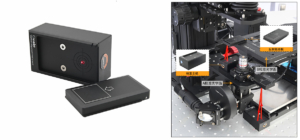
Assembly
Application Examples

.jpg)