Description
Product Description

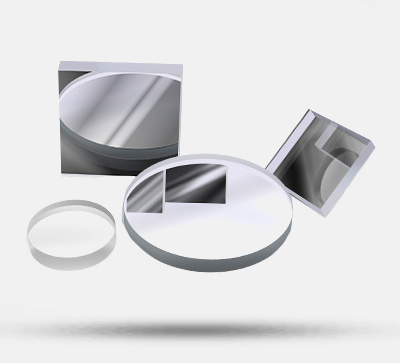
- The inclined surface is coated with a reflective film to achieve front surface reflection;
- The surface is a right triangle, where the angle between two sides is 90 degrees;
- Deflects the incident light by 90°, turning the originally horizontal light to the vertical direction;
- Right-angle side size: 25.4mm;
The right-angle reflector substrate is an isosceles right triangular prism, where the angle between two sides is 90°, and the outer surface of the inclined surface is a reflective surface coated with a broadband dielectric film.
| Item | Specification |
| Material | K9 Optical Glass |
| Coating | Ordinary Aluminum Film + Protection |
| Applicable Wavelength | 400-800nm |
| Surface Figure | λ/4@633nm |
| Angle Error | ±30′ |
| Dimensional Tolerance | ±0.1mm |
| Tower Difference | <10′ |
| Surface Finish | 40/20-60/40 |
| Chamfer | 0.2*45° |
| Model | Size | Transmittance |
| RPM-25.4 | 25.4*25.4*25.4mm | <90% |
Curve

Technical Description

I. Plane Reflector
- Dielectric Film Reflector: A multi-layer dielectric film is plated on the surface of the optical element to make a certain wavelength interfere and superimpose, thereby enhancing the reflectivity. The dielectric film has high reflectivity, can be used in a wide wavelength spectrum, has no absorption of light, is hard and not easy to be damaged, and is suitable for optical systems of multi-wavelength lasers. This type of reflector has a thick film layer, is angle-sensitive, and has a high cost.
- Dielectric Film Reflector: The substrate material of the laser line reflector is ultraviolet fused silica, and its surface high-reflection film is Nd:YAG dielectric film, which is plated by electron beam evaporation and ion-assisted deposition processes. Compared with K9 material, ultraviolet fused silica has better uniformity and lower thermal expansion coefficient, making it particularly suitable for applications in the ultraviolet to near-infrared band, high-power lasers and imaging fields.
- Ultra-Fast Reflector: The substrate material of the ultra-fast reflector is fused silica, and its surface high-reflection film is a low group delay dispersion dielectric film, which is plated by ion beam sputtering (IBS) process. Fused silica has a lower thermal expansion coefficient and extremely high thermal shock stability, making it particularly suitable for high-power femtosecond pulse lasers and imaging fields.
- Super Reflector: The super reflector is made by plating multi-layer dielectric reflective films with alternating high and low refractive indices on an ultraviolet fused silica substrate. The reflectivity is improved by increasing the number of film layers, which can make the reflectivity of the super reflector better than 99.99% at the design wavelength, suitable for optical systems with high reflectivity requirements.
- Metal Film Reflector: Metal film reflectors are very suitable for optical path deflection of wide-spectrum light sources, and have high reflectivity in a wide spectrum range. Metal films are easily oxidized, discolored or peeled off in high-humidity environments. Therefore, metal film reflectors are generally plated with a layer of silicon dioxide protective film on their surface to isolate the metal film from direct contact with air, avoiding the metal film from being oxidized and affecting optical performance.

II. Right-Angle Prism Reflector
Usually, the right-angle sides are coated with anti-reflection films, and the hypotenuse is coated with reflective films. The right-angle prism itself has a large contact area and typical angles such as 45° and 90°. Therefore, compared with ordinary reflectors, the right-angle prism is easier to install and has better stability and strength against mechanical stress.

III. Off-Axis Parabolic Reflector
The off-axis parabolic reflector is a surface reflector whose reflective surface is a part cut from the parent paraboloid. The off-axis parabolic reflector can be used to focus parallel light beams or collimate point light sources, and its off-axis design can separate the focal point from the optical path. Compared with lenses, the use of off-axis parabolic reflectors will not produce spherical aberration and chromatic aberration, and will not introduce phase delay and absorption loss, making it very suitable for femtosecond pulse lasers.

IV. Hollow Roof Prism Reflector
The hollow roof prism reflector is composed of two right-angle prisms and a rectangular substrate, made of Borofloat. Borofloat material has extremely high surface flatness and good optical performance, with superior light transmittance and extremely low fluorescence intensity in the entire spectral range. At the same time, the inclined surface of the right-angle prism is plated with a silver film with a metal protective layer, which has high reflectivity in the visible and near-infrared bands. The inclined surfaces of the two prisms are placed opposite each other, and the dihedral angle is 90±10 arcsec. The hollow roof prism reflector can reflect the light incident on the hypotenuse of the prism from the outside. Unlike the plane reflector, the reflected light is still parallel to the incident light, avoiding the influence of beam interference, and is more accurate than manually adjusting two reflectors.

(1) The right-angle reflector substrate is an isosceles right triangular prism, where the angle between two sides is 90°, and the outer surface of the inclined surface is a reflective surface coated with a broadband dielectric film. When in use, make the reflective surface perpendicular to the working plane or at 45°, which can deflect the light by 90° for beam offset or beam combination/separation.

(2) When using 30mm cage system and SM1 lens sleeve products to build optical devices, these right-angle reflectors can be installed in the cube, which can save time for aligning the reflectors in the device. High accuracy and better flexibility are achieved.

Assembly

Application Examples