Description
Product Description

- It can split multi-wavelength laser or white light source into transmitted light and reflected light, and the semi-reflective mirror in the broadband spectral region can also be used as an element for spectrometer measurement;
- Since the characteristics of S-polarization and P-polarization are not much different, it can also split light normally when using a laser light source or a linearly polarized light source (please refer to the notes);
- Due to the use of multi-layer dielectric films, there is almost no light loss caused by absorption of the film system, and light can be split effectively;
- When using linearly polarized light such as laser, the reflectance or transmittance changes with the polarization direction. If you want to adjust the beam splitting ratio to 1:1, please tilt the polarization direction by 45° or use circularly polarized light.
A beam splitter plate is a translucent optical window that uses a coating to split a beam of light into two separate beams.
| Parameter | Specification |
| Material | Synthetic Quartz |
| Applicable Wavelength | 400-700nm |
| Reflection: Transmission | 1:1 |
| Transmitted Beam Deviation | <5’ |
| Laser Damage Threshold | 0.3J/cm² (Pulse width 10ns, Repetition frequency 20Hz) |
| Incident Angle | 45° |
| Polarization Condition of Incident Angle | 45° Linearly Polarized Light, Circularly Polarized Light, Natural Light |
| Effective Range | 90% of the Overall Dimension |
| Coating | Front Side: Multi-layer Dielectric Film; Back Side: Anti-Reflection Film |
| Product Model | Parameters |
| PSMH-S38-M | Specification: 38*32*1.1mm; |
| PSMH-S38-M | Specification: 38*32*1.1mm; |
| PSMH-S55-M | Specification: 55*55*1.1mm; |
| PSMH-S55-M | Specification: 55*55*1.1mm; |
Technical Description
– Beam Splitter Prism Series
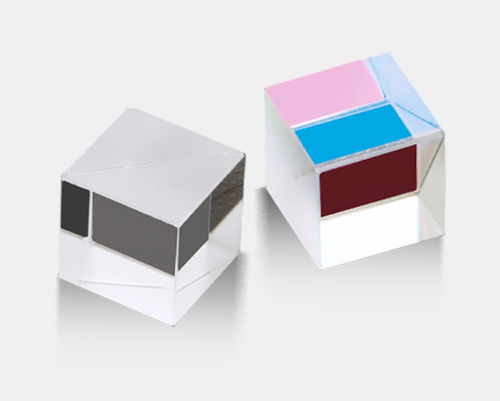
Widely used in image science, laser measurement and other fields. A beam splitter is an optical device that can split a beam of light into two beams, and it is an important component in optical interferometers, most commonly in the form of a cube.
Classification of Beam Splitters:
By component: Beam Splitter Plate, Beam Splitter Prism;
By polarization state: Polarizing Beam Splitter Prism, Non-Polarizing Beam Splitter Prism;
By bandwidth: Narrowband Beam Splitter Prism, Broadband Beam Splitter Prism;
Compared with beam splitter plates, the optical paths of reflected and transmitted light of beam splitter prisms are equal. When transmitting light, the beam splitter prism is not affected by light deviation, so there will be no problems of beam translation, ghosting and interference. It is used for beam splitting and imaging, and no long-term calibration is required when incident at 45° angle.
| Type | Polarization State of Incident Light | Polarization State of Emergent Light |
| Ordinary Beam Splitter Prism | 45° Linearly Polarized Light | Partially Polarized Light |
| Circularly Polarized Light | ||
| Natural Light | ||
| Polarizing Beam Splitter Prism | Arbitrary Polarized Light | S-Polarized Light and P-Polarized Light |
| Natural Light | ||
| Non-Polarizing Beam Splitter Prism | Arbitrary Polarized Light | Same as the Polarization State of Incident Light |
| Natural Light | ||
| Beam Splitter Plate | 45° Linearly Polarized Light | Partially Polarized Light |
| Beam Splitter Wedge | Circularly Polarized Light | Partially Polarized Light |
| Natural Light | ||
| Single-Wavelength Polarizing Beam Splitter Plate | Arbitrary Polarized Light | S-Polarized Light and P-Polarized Light |
| Natural Light | ||
| Single-Wavelength Non-Polarizing Beam Splitter Plate | Arbitrary Polarized Light | Same as the Polarization State of Incident Light |
| Natural Light |
T: Transmittance; R: Reflectance; P-polarization/S-polarization;

Figure 1: Polarizing Beam Splitter Prism; Figure 2: Non-Polarizing Beam Splitter Prism;

When light is obliquely incident on the glass surface, its reflectance changes with the polarization direction of the incident light. The light wave vibrating in the plane formed by the normal of the glass surface and the incident beam is called P-polarization, and the light wave vibrating in the direction orthogonal to P-polarization is called S-polarization. Polarization states in other directions can be regarded as the result of synthesis of P-polarization and S-polarization in different proportions.
The reflectance of P-polarization and S-polarization is determined by the incident angle and the refractive index of the glass. Since they follow different laws, the reflectance of P-polarization and S-polarization is also different.

– Basic Principle of Optical Coating
Optical thin film technology is generally used to control the reflectance and transmittance of the substrate to the incident beam. Coating is a method of plating a layer of transparent dielectric film or a layer of metal film on the surface of the material by physical or chemical means. The purpose is to change the reflection and transmission characteristics of the material surface to meet different needs. To eliminate the reflection loss on the surface of optical components and improve imaging quality, coating one or more layers of transparent dielectric films is called anti-reflection film or anti-reflection coating. With the development of laser technology, different requirements for the reflectance and transmittance of the film layer have promoted the development of multi-layer high-reflection films and broadband anti-reflection films. For various application needs, polarizing reflective films, color beam splitting films, cold light films and interference filters are manufactured by using high-reflection films.
After the surface of the optical component is coated, light undergoes multiple reflections and transmissions between the film layers to form multi-beam interference. By controlling the refractive index and thickness of the film layer, different intensity distributions can be obtained, which is the basic principle of interference coating.

(1) The beam splitter plate only considers energy splitting and not polarization state. The incident light requirements are: 45° linearly polarized light, circularly polarized light, natural light, that is, the S component and P component must be approximately equal (difference <5%).

(2) Can be used with multiple series of Oeabt products;

Assembly

Application Examples