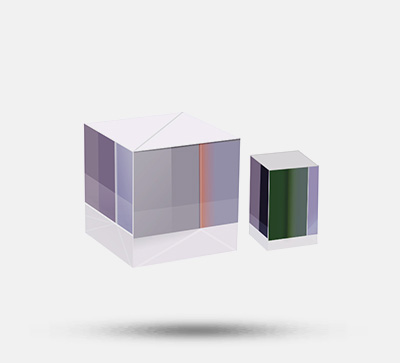
Description
Product Description

- Using 2 polarizers, many polarization experiments can be performed (parallel Nicol, crossed Nicol);
- Put 2 polarizers into the light source and change the polarization axis direction of each polarizer to realize a wide range of dynamic light intensity adjustment;
- The polarizer is thin and light, and can be installed in narrow gaps in the optical system;
- Due to its extinction characteristics in the broadband of visible light, it can also be used in the sensitive color method using white light; in addition to polarization characteristics, the polarizer also has losses caused by absorption;
- Since the extinction ratio changes with wavelength, the light beam may appear purple after extinction.
The polarizer has the function of shielding and transmitting incident light, which can transmit one of longitudinal light or transverse light and shield the other. It can convert incident light, composite light, or monochromatic light into linearly polarized light, and then completely extinguish the light through the polarizer.
| Product Parameters | Parameter Information |
| Structure | Dichroic Polarizing Film; Filter Bonded Between 2 Plastic Plates |
| Applicable Wavelength | 400-780nm |
| Effective Thickness of Polarizing Film | 155±10%µm |
| Single Transmittance | 42.0±1.5% |
| UV CUT (at 380nm) | ≦3.0% |
| Cross Transmittance | ≦0.08% |
| Polarization Degree | ≧99.9% |
| Haze Value | 2.5±2.0% |
| Surface Hardness | ≧3H |
| Model | Parameters |
| PBSW-C1 | Ø25.4*1.4mm |
| PBSW-C05 | Ø12.7*1.85mm |
Technical Description
– Polarizer Series
The polarizer has the function of shielding and transmitting incident light, which can transmit one of longitudinal light or transverse light and shield the other. It is a composite material laminated by polarizing film, inner protective film, pressure-sensitive adhesive layer and outer protective film. There are two types: black and white and color; according to the application, it can be divided into three types: transmission, transflection and retrotransmission.
Generally, the light emitted by a light source has its vibration plane not limited to a fixed direction but uniformly distributed in all directions. This kind of light is called natural light. The polarization of light is the most direct and powerful evidence of the transverse wave nature of light. After natural light passes through a polarizer, it becomes light with a certain vibration direction. The light whose light vector vibrates only along a fixed direction is linearly polarized light. The polarizer only allows vibrations parallel to the polarization direction to pass through, and absorbs light vibrating perpendicular to this direction.


– The polarization phenomenon of light can be observed with the help of experimental equipment:
P1 and P2 are two identical polarizers. Observe natural light (such as light or sunlight) directly through a polarizer P1. Although the light passing through the polarizer becomes polarized light, the human eye cannot distinguish polarized light, so it cannot be detected. If we fix the orientation of polarizer P1 and slowly rotate polarizer P2, we will find that the intensity of the transmitted light changes periodically with the rotation of P2, and every 90° rotation, the light intensity repeats the change from maximum to minimum; continuing to rotate P2, the light intensity gradually increases from near zero to maximum again.
The transmitted light through the polarizer has its vibration restricted to a certain vibration direction. We call the first polarizer P1 the “polarizer”, whose function is to convert natural light into polarized light, but the human eye cannot distinguish polarized light. It must be checked by the second polarizer P2. Rotate P2. When its polarization direction is parallel to the polarization plane of the polarized light, the polarized light can pass smoothly, and there is brighter light behind P2. When the polarization direction of P2 is perpendicular to the polarization plane of the polarized light, the polarized light cannot pass, and it becomes dark behind P2. The second polarizer helps us identify polarized light, so it is also called an “analyzer”.


| Test Conditions | Variation |
| Heat Resistance: 80°C, 500 hours | Single Transmittance: ≦±3.0%; Polarization Degree: ≦±3.0%; Haze: ≦±5.0%; |
| Heat Resistance: 80°C, 500 hours | Single Transmittance: ≦±3.0%; Polarization Degree: ≦±3.0%; Haze: ≦±5.0%; |
| Moisture Resistance: 60°C/90%RH, 500 hours | Single Transmittance: ≦±5.0%; Polarization Degree: ≦±5.0%; Haze: ≦±5.0%; |
| Moisture Resistance: 60°C/90%RH, 500 hours | Single Transmittance: ≦±5.0%; Polarization Degree: ≦±5.0%; Haze: ≦±5.0%; |
| Light Resistance: 400W Mercury Lamp/30cm, 500 hours | Single Transmittance: ≦±3.0%; Polarization Degree: ≦±3.0%; Haze: ≦±5.0%; |
| Light Resistance: 400W Mercury Lamp/30cm, 500 hours | Single Transmittance: ≦±3.0%; Polarization Degree: ≦±3.0%; Haze: ≦±5.0%; |
| Low Temperature Resistance: -40℃, 500 hours | Single Transmittance: ≦±3.0%; Polarization Degree: ≦±3.0%; Haze: ≦±5.0%; |
| Low Temperature Resistance: -40℃, 500 hours | Single Transmittance: ≦±3.0%; Polarization Degree: ≦±3.0%; Haze: ≦±5.0%; |
| Thermal Shock: -40℃(1H)~85℃(1H) 100 cycles | Single Transmittance: ≦±3.0%; Polarization Degree: ≦±3.0%; Haze: ≦±5.0%; |
| Thermal Shock: -40℃(1H)~85℃(1H) 100 cycles | Single Transmittance: ≦±3.0%; Polarization Degree: ≦±3.0%; Haze: ≦±5.0%; |
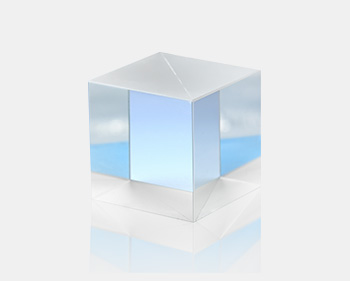
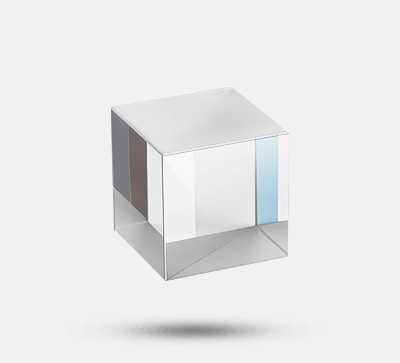
(1) A cube-shaped half-mirror that equally splits unpolarized light such as white light sources or LED light sources into transmitted light and reflected light; regardless of the polarization direction of linearly polarized light, the splitting ratio (1:1) of reflected light and transmitted light remains unchanged.


Assembly

Application Examples