Description
Product Description

- The lens cannot converge light alone or form a real image. Please use it in combination with a convex lens;
- Light incident on the plano-concave lens has directionality. Be sure to incident parallel light from the concave side; otherwise, spherical aberration will increase, and the optical performance of the optical system may degrade;
- When using high-energy pulsed lasers, flash may occur after the reflected light from the concave surface accumulates into a focal spot on the optical path. For special cases such as using pulsed lasers, please incident the laser from the planar side;
- The outer edge of the concave surface is chamfered, so the edge thickness (te) may sometimes be smaller than the design value. Please use the planar side on the reverse as the reference surface;
- The concave lens model is indicated by “N”: Uncoated type – model ending with N; Coated type – model ending with NM.
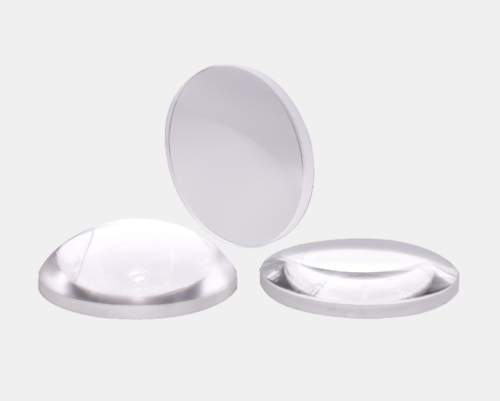
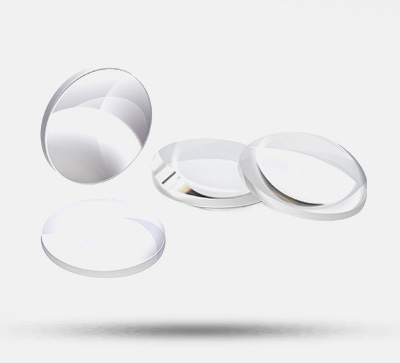
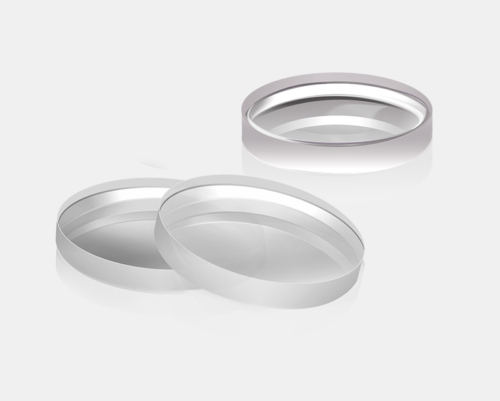
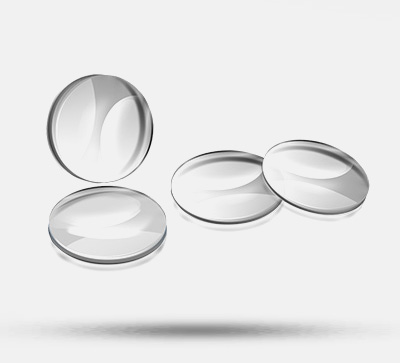
The spherical lens series includes four types of spherical lenses for selection: plano-convex lens, plano-concave lens, biconvex lens and biconcave lens.
The plano-concave lens has a simple structure and can diverge collimated laser light. It cannot converge light alone or form a real image. When combined with a convex lens, it can be used to expand the beam diameter and the illumination area of illumination light.
| Uncoated Type | Coated Type | |
| Material | BK7 | BK7 |
| Diameter | Ø1 inch (25.4mm) | Ø1 inch (25.4mm) |
| Refractive Index | ne=1.519 | ne=1.519 |
| Wavelength | 200~2000nm | 400-700nm |
| Transmittance | 80%-85% | 90% |
| Clear Aperture | 90% | 80% |
| Surface Quality | 40-60 | 20-40 |
| Model | Parameters |
| OLB-I1-30N(M) | f-30; te8.6; tc2.0; fb-31.3; ‘<1 |
| OLB-I1-30N(M) | f-30; te8.6; tc2.0; fb-31.3; ‘<1 |
| OLB-I1-50N(M) | f-50; te5.3; tc2.0; fb-51.3; ‘<1 |
| OLB-I1-50N(M) | f-50; te5.3; tc2.0; fb-51.3; ‘<1 |
| OLB-I1-70N(M) | f-70; te4.3; tc2.0; fb-51.3; ‘<1 |
| OLB-I1-70N(M) | f-70; te4.3; tc2.0; fb-51.3; ‘<1 |
| OLB-I1-100N(M) | f-100; te3.6; tc2.0; fb-101.3; ‘<1 |
| OLB-I1-100N(M) | f-100; te3.6; tc2.0; fb-101.3; ‘<1 |
| OLB-I1-150N(M) | f-150; te3.6; tc2.0; fb-151.3; ‘<1 |
| OLB-I1-150N(M) | f-150; te3.6; tc2.0; fb-151.3; ‘<1 |
| OLB-I1-200N(M) | f-200; te2.8; tc2.0; fb-151.3; ‘<1 |
| OLB-I1-200N(M) | f-200; te2.8; tc2.0; fb-151.3; ‘<1 |
| *Note: OD=Outer Diameter; f=Focal Length; te=Edge Thickness; tc=Center Thickness; fb=Back Focal Length; ‘=Eccentricity; Unit: mm | *Note: OD=Outer Diameter; f=Focal Length; te=Edge Thickness; tc=Center Thickness; fb=Back Focal Length; ‘=Eccentricity; Unit: mm |
Technical Description
– Spherical Lens Series
A lens is an optical element made of a transparent material with a surface that is part of a sphere. It is manufactured according to the law of light refraction and is a refracting mirror consisting of two spherical surfaces (parts of spheres), or one spherical surface (part of a sphere) and one plane. The images it forms can be either real or virtual. Single lenses can generally be divided into two main categories: convex lenses and concave lenses.
- Convex lens: Thicker in the middle and thinner at the edges, including three types: biconvex, plano-convex, and meniscus (concavo-convex);
- Concave lens: Thinner in the middle and thicker at the edges, including three types: biconcave, plano-concave, and meniscus (concavo-convex).
The imaging law of convex lenses states that when an object is placed outside the focal point, an inverted real image is formed on the other side of the convex lens, and the real image can be reduced, equal in size, or magnified. The smaller the object distance, the larger the image distance and the larger the real image. When an object is placed inside the focal point, an upright and magnified virtual image is formed on the same side of the convex lens. The smaller the object distance, the smaller the image distance and the smaller the virtual image. In optics, an image formed by the convergence of actual light rays is called a real image, which can be received by a light screen; on the contrary, a virtual image can only be perceived by the human eye. The distinction between real and virtual images: all real images are inverted, while all virtual images are upright. The terms “upright” and “inverted” are, of course, relative to the original object.
A concave lens is also known as a negative spherical lens. The center of the lens is thin and the periphery is thick, with a concave shape, hence the name. Concave lenses have a diverging effect on light. After parallel light rays pass through a concave spherical lens and are refracted, they diverge and become divergent rays, which cannot form a real focal point. Along the reverse extension lines of the diverging rays, they intersect at point F on the same side as the incident rays, forming a virtual focal point.

- A plano-convex lens is suitable for situations where one conjugate distance is more than five times the other. The performance of this lens shape is suitable for infinite conjugate ratio (focusing collimated light or collimating point light sources).
- A biconvex lens is suitable for situations where one conjugate distance is 0.2 to 5 times the other. The performance of this lens shape is suitable for situations where the object distance is the same as the image distance.
- A plano-concave lens is suitable for situations where one conjugate distance is more than five times the other. They introduce negative spherical aberration and can be used to balance the spherical aberration introduced by a single lens with a positive focal length.
- A biconcave lens has a negative focal length and is usually used to increase the divergence of converged light.
Each of these lenses is suitable for different applications. Plano-convex and biconvex lenses are positive lenses (i.e., they have positive focal lengths) and focus collimated light to a focal point, while plano-concave and biconcave lenses are negative lenses and diverge collimated light. The shape of each single lens minimizes aberration for a specific conjugate ratio, which is defined as the ratio of the object distance to the image distance (these are called conjugate distances).
| Category | Function | Applicable Lens |
| Light Convergence & Imaging | Beam Convergence | Plano-convex Lens |
| Beam Collimation | Plano-convex Lens | |
| Illumination | Biconvex Lens / Plano-convex Lens | |
| Imaging (Microscope) | Biconvex Lens / Plano-convex Lens | |
| Beam Shaping | Beam Expansion | Plano-convex Lens + Plano-concave Lens |
| Line Light | Plano-convex Lens + Cylindrical Lens | |
| Irregular Beam | Cylindrical Lens |
– Basic Principle of Optical Coating
Optical thin film technology is generally used to control the reflectance and transmittance of a substrate to an incident light beam. Coating is a process of depositing a layer of transparent dielectric film or a layer of metal film on the material surface by physical or chemical methods, aiming to change the reflection and transmission characteristics of the material surface to meet different requirements. To eliminate the reflection loss on the surface of optical components and improve imaging quality, one or more layers of transparent dielectric films are coated, which are called anti-reflection films or anti-reflective coatings. With the development of laser technology, different requirements for the reflectance and transmittance of film layers have promoted the development of multi-layer high-reflection films and broadband anti-reflection films. For various application needs, polarizing reflective films, color beam splitting films, cold light films and interference filters are manufactured using high-reflection films.
After the surface of an optical component is coated, light undergoes multiple reflections and transmissions between the film layers, forming multi-beam interference. By controlling the refractive index and thickness of the film layers, different light intensity distributions can be obtained, which is the basic principle of interference coating.

(1) The plano-concave lens has a simple structure and can diverge collimated laser light. It cannot converge light alone or form a real image. When combined with a convex lens, it can be used to expand the beam diameter and the illumination area of illumination light.


(2) The edges of some thin lenses have a yellowish part. Since edging of ultra-thin lenses will affect the service life and performance of the lenses, edging is not performed. This does not hinder the normal use of the lenses and is not a quality issue.

- Non-edged lens: No edging, slightly yellowish edges, which is a normal phenomenon and does not affect use; durable and sturdy.
- Edged lens: The front edges and sharp corners are all ground off, with a good hand feel; durable and sturdy.
Assembly

Application Examples
The spherical lens series includes four types of spherical lenses for selection: plano-convex lens, plano-concave lens, biconvex lens and biconcave lens.
The plano-concave lens has a simple structure and can diverge collimated laser light. It cannot converge light alone or form a real image. When combined with a convex lens, it can be used to expand the beam diameter and the illumination area of illumination light.