Description
Product Description

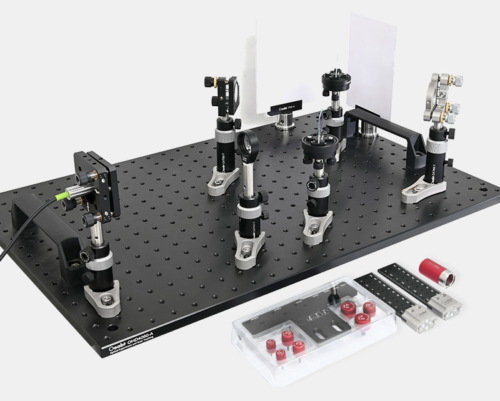
- Oeabt teaching demonstration series products are designed to promote the development of physics, optics, photonics and various emerging research fields through various classic experiments. Each teaching kit contains all necessary components and an instruction manual with detailed device descriptions and teaching operation guidelines.
The basic structure of a quantum eraser experiment includes two beam splitters, two reflectors, one beam combiner and one polarizer.
| Light Source Components | Light Source Components | Light Source Components | Light Source Components |
| Item | Model | Remarks | Quantity |
| Ø12mm Laser Source | OM-12A515-3-G | Wavelength 515nm, Power 3mW | 1 |
| Laser Mounting Hole | POL-12 | Mounting Aperture: Ø12mm | 1 |
| Cage Adjustable Mirror Mount | MC-S1 | Smooth Hole Type, Compatible with Ø1-inch Optical Components, ±5° Tilt and ±3mm Translation | 1 |
| Reflector Components | Reflector Components | Reflector Components | Reflector Components |
| Item | Model | Remarks | Quantity |
| Aluminum Film Reflector | TFA-C1 | Ø25.4*5mm, Applicable Wavelength: 380-780nm | 2 |
| Two-Axis Adjustable Mirror Mount | MK100-A | Compatible with Ø1-inch Optical Components, Adjustable Tilt ±4° | 1 |
| Three-Axis Adjustable Mirror Mount | OST-K100 | Compatible with Ø1-inch Lenses, Tilt Adjustable ±4°~±6° | 1 |
| Beam Splitter Components | Beam Splitter Components | Beam Splitter Components | Beam Splitter Components |
| Item | Model | Remarks | Quantity |
| Beam Splitter Plate | PSMH-S38-M | 38*32*1.1mm, Applicable Wavelength: 400-700nm, Incident Angle 45° | 2 |
| Tilt Adjustment Mount | LB-A3 | ±4° Tilt, Z-axis ±2mm | 2 |
| Rectangular Mount | LFM1-A | Mounting Thickness <3mm, Optical Components with Width 28-40mm | 2 |
| Lens Components | Lens Components | Lens Components | Lens Components |
| Item | Model | Remarks | Quantity |
| Plano-Convex Lens | OLB-I1-70PM | Ø1 inch, f=70mm, Anti-Reflection Coating: 400-700nm | 1 |
| Lens Mount | SM-R1 | Compatible with Ø1-inch Optical Components, SM1 Thread | 1 |
| Polarizer Components | Polarizer Components | Polarizer Components | Polarizer Components |
| Item | Model | Remarks | Quantity |
| Linear Polarizer | PBSW-C1 | Ø1 inch, Applicable Wavelength: 400-780nm | 3 |
| Rotary Mount | SM-RP1 | 360° Rotation, Graduation 2°; Zero Scale Graduation 1°; Vernier Scale 5 Arc Minutes | 3 |
| Mechanical Components | Mechanical Components | Mechanical Components | Mechanical Components |
| Item | Model | Remarks | Quantity |
| Optical Breadboard | OHD4060-A | 400*600*13mm, M6 Screw Hole Array, 5 Counterbores | 1 |
| Rod Holder | CAT57-T | Telescopic Rod Holder, L=57mm, Knob Height 8mm, Compatible with Ø12.7mm Rods, M6 Screw Holes | 9 |
| PCAH2-S | Ø12.7mm Rod, L=50.8mm, M4 Screw Hole on One End and M6 Screw Hole on the Other End | 9 | |
| PCA31-S | Rod Base, M6 Bolt | 9 | |
| M-BASE-C | Fork-Type Pressure Plate, Fixing the Position of the Rod Holder | 9 | |
| Light Spot Observation White Screen | PIS-A2 | White Board: 148*90*4.4mm | 2 |
| CFP0.5-S【M4】 | White Screen Rod, Ø1 inch, L=12.7mm | 2 | |
| Tools and Accessories | MHR-B1 | Magnetic Straightedge with Metric/Imperial Scale | 2 |
| SPW-TH | Wrench Tool Holder, Including 7 Hand-Tightening Screws and 7 Hex Wrenches | 1 | |
| SPW-SM150 | Retaining Ring Wrench, L=50mm, with Scale, Compatible with SM1 Retaining Rings | 1 | |
| Screw Pack | Complimentary | – |
Technical Description
☑ Quantum Eraser Experiment
– Experiment Summary
The quantum eraser experiment further verifies that micro-particles have both wave nature and particle nature, the so-called wave-particle duality. In the traditional double-slit interference experiment, particles passing through the double slits form an interference pattern on the screen, indicating that particles have wave nature. However, measuring which slit the particle passes through will destroy the interference pattern, showing particle nature. This makes it impossible for us to observe wave nature and particle nature at the same time. In the quantum eraser experiment, a single photon enters the Mach-Zehnder interferometer. The photon is “marked” as having horizontal or vertical polarization state through two linear polarizers, indicating which path they pass through the interferometer. The interference pattern (wave property) and path information (particle property) cannot be measured simultaneously, because measuring path information will destroy the interference pattern. A third polarizer is placed at the position where the two paths of light are combined, which will “erase” the path information, making the photon lose the mark again, thus restoring the interference pattern.
Unlike the original quantum eraser experiment, this kit does not use single photons, but uses a green continuous wave (CW) laser light source, whose emitted light beam is visible to the naked eye. Although the experimental results can be explained by classical physics, they can be perfectly analogous to the single-photon quantum eraser experiment when described by quantum mechanics.
—— Experimental Principle:
The specific steps are as follows:
(1) Double-Slit Interference: After particles (such as photons) pass through the double slits, an interference pattern is formed on the screen, showing their wave nature.
(2) Path Information Recording: When the detector records which slit the particle passes through, the interference pattern disappears, indicating that the wave nature of the particle is destroyed and particle nature is shown.
(3) Quantum Erasure: Introduce a quantum eraser (such as a polarizer or entangled photons), and “erase” the path information through specific operations to restore the interference pattern, even if the path information has been recorded.

—— Experimental Objectives:
(1) Verify Wave-Particle Duality: Demonstrate the wave nature and particle nature of micro-particles (such as photons) under different experimental conditions.
(2) Study the Impact of Quantum Measurement: Explore how measurement affects the state of a quantum system and reveal the impact of quantum measurement on particle behavior.
(3) Quantum Entanglement and Non-Locality: Demonstrate the phenomena of quantum entanglement and non-locality through quantum erasers and entangled states.
(4) Education and Popular Science: Help understand basic quantum mechanics concepts through intuitive experiments and stimulate interest in learning and research.


—— Kit List:
The basic structure of a quantum eraser experiment includes two beam splitters, two reflectors, one beam combiner and one polarizer.

—— Experimental Content
Each teaching kit contains all necessary components and an instruction manual with detailed device descriptions and teaching operation guidelines.

Assembly

Application Examples