Description
OEDU-PLE Polarization of Light Experiment
Product Description
The Oeabt Educational Demonstration Series is designed to advance physics, optics, photonics, and various emerging research fields through classic experiments. Each educational kit includes all necessary components and an instruction manual with detailed setup and operational guidance.
The Polarization of Light Experiment demonstrates the polarization phenomenon of light and its applications in science and technology by investigating polarization properties and behavior in different media and optical devices.
Light Source Components
| Item | Model | Notes | Qty |
| Ø18 mm Laser Source | — | Wavelength 532 nm, Power 10 mW, with power adapter | 1 |
| Laser Mounting Hole | — | Mounting bore: Ø19.5 mm | 1 |
| LED Light Source | LED-D1-MAX6K | White light 6000–6500 K, DC 12 V, 2 W Max | 1 |
| Dimming Controller | LEDOTB-1000 | 1000 mA, continuous & pulse mode supported | 1 |
| Ø1” Lens Sleeve | CSA-24 | SM1 thread, L=24 mm, with 1 retaining ring | 1 |
| 30 mm Through-Hole Cage Plate | CSJ-31 | Limit hole Ø30.6 mm, setscrew clamping | 1 |
Polarizer Components
| Item | Model | Notes | Qty |
| Linear Polarizer | PBSW-C1 | Ø1”, operating wavelength 400–780 nm | 2 |
| Rotation Mount | SM-RP1 | 360° rotation, 2° division; main scale 1°, vernier 5 arcmin | 2 |
Waveplate Mount Components
| Item | Model | Notes | Qty |
| Self-Centering Mount | CRD-XA | Self-centering spring clamp: Ø3.8–45.0 mm optics, M4 thread | 1 |
| Rotation Mount | CRD-S2 | 360° rotation, 2° division | 1 |
| Ø6 mm Cage Rod | PCM-E1 | Ø6 mm, L=25.4 mm, 4-40 thread | 4 |
| Ø2” Adjustable Sleeve | CSM2-T8 | SM2 internal & external thread, 8 mm threaded section | 1 |
| Sleeve Clamping Ring | SCR2 | Secures Ø2” sleeve, M4 thread | 1 |
| 1/2 Waveplate | — | Used as polarization analyzer | 1 |
| 1/4 Waveplate | — | Used as polarization analyzer | 1 |
Mechanical Components
| Item | Model | Notes | Qty |
| Optical Breadboard | OHD5010-M | 500×100×11 mm, M4/M6 hole array, 4 counterbores | 1 |
| Rubber Feet | — | For breadboard | 4 |
| Post Holder | CAT80-T | Telescopic, L=80 mm, twist height 8 mm | 4 |
| Post | PCAH2.5-S | Ø12.7 mm, L=63.5 mm, M4/M6 threaded ends | 5 |
| Post Base | PCA31-S | M6 bolt | 4 |
| Fork Clamp | M-BASE-C | Secures post holders | 5 |
| Beam Observation White Screen | PIS-A2 | 148×90×4.4 mm | 1 |
| CFP1-S (M4) | Ø1” post, L=25.4 mm, M4 thread | 1 | |
| Tool Kit | SPW-TH | With 7 thumb screws & 7 hex keys | 1 |
| Retaining Ring Wrench | SPW-SM150 | L=50 mm, scaled, for SM1 rings | 1 |
| Screw Pack | — | Complimentary | — |
Technical Description
Experiment Summary
The Polarization of Light Experiment demonstrates polarization phenomena and their scientific and industrial applications by examining polarization properties and interactions with media and optical devices. Experiments include generation and detection of linear and circular polarization, and polarization modulation using waveplates (1/2 and 1/4 waveplates).
Experiment Principle
Polarization States of Light
- Linear Polarized Light: The electric field oscillates in a fixed plane; generated by polarizers or reflection at Brewster’s angle.
- Partially Polarized Light: Unequal amplitude in different directions; formed by reflection, transmission, or scattering.
- Elliptical Polarized Light: The electric field traces an ellipse; composed of two perpendicular, phase-correlated electric vectors.
- Circular Polarized Light: Special case of elliptical polarization; generated by passing linear polarized light through a 1/4 waveplate.
- Natural Light: Random polarization direction; e.g., sunlight and incandescent light.

Waveplate Functions
- 1/4 Waveplate: Converts linear polarization to circular/elliptical polarization, depending on incident angle to the optical axis.
- 1/2 Waveplate: Rotates the polarization direction of linear light or reverses the handedness of circular light.
Experiment Objectives
- Study polarization properties and verify polarization generation through observation.
- Master polarization modulation using 1/4 and 1/2 waveplates, and understand waveplate effects on polarization state.
- Develop optical experimental skills and deepen understanding of polarization phenomena through handson operation.


Kit Contents
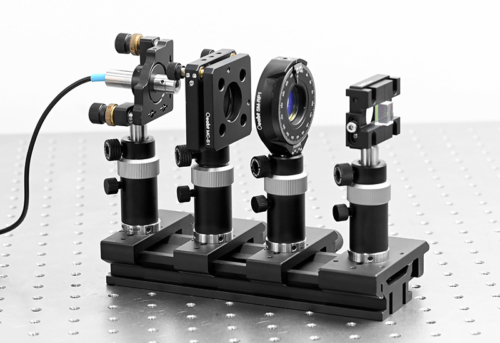
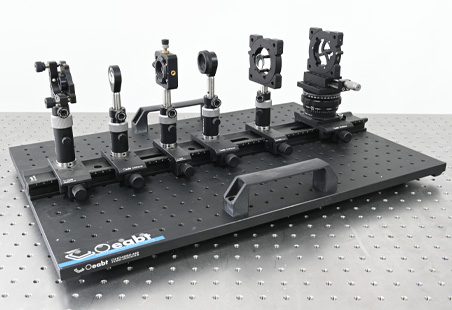
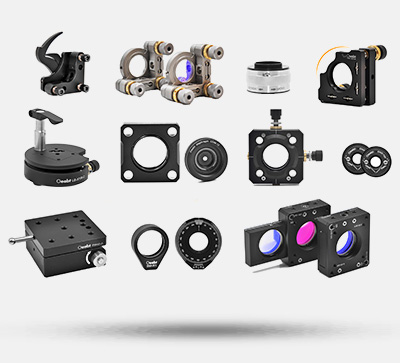
The kit provides a complete setup for studying light polarization and its applications in science and technology.

Experiment Contents
- Optical path setup and alignment
- Handson operation and observation
- Troubleshooting and Q&A

Assembly

Application Examples