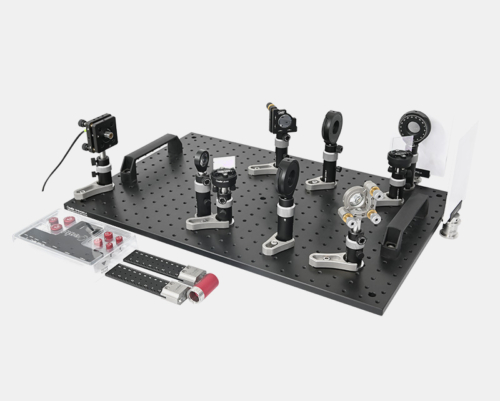
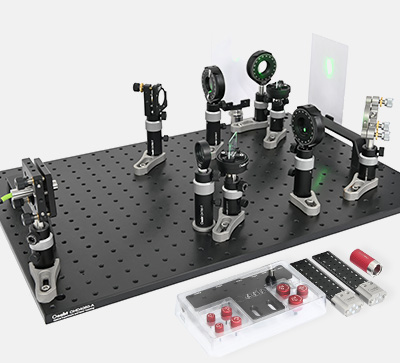
Description
Product Description

- Oeabt teaching demonstration series products are designed to promote the development of physics, optics, photonics and various emerging research fields through various classic experiments. Each teaching kit contains all necessary components and an instruction manual with detailed device descriptions and teaching operation guidelines.
The basic structure of a Mach-Zehnder Interferometer includes two beam splitters, two reflectors, and one beam combiner.
| Light Source Components | Light Source Components | Light Source Components | Light Source Components |
| Item | Model | Remarks | Quantity |
| Ø12mm Laser Source | OM-12A520-3-G | Wavelength 520nm, Power 3mW | 1 |
| Laser Mounting Hole | POL-12 | Mounting Aperture: Ø12mm | 1 |
| Cage Adjustable Mirror Mount | MC-S1 | Smooth Hole Type, Compatible with Ø1-inch Optical Components, ±5° Tilt and ±3mm Translation | 1 |
| Reflector Components | Reflector Components | Reflector Components | Reflector Components |
| Item | Model | Remarks | Quantity |
| Aluminum Film Reflector | TFA-C1 | Ø25.4*5mm, Applicable Wavelength: 380-780nm | 2 |
| Two-Axis Adjustable Mirror Mount | MK100-A | Compatible with Ø1-inch Optical Components, Adjustable Tilt ±4° | 1 |
| Three-Axis Adjustable Mirror Mount | OST-K100 | Compatible with Ø1-inch Lenses, Tilt Adjustable ±4°~±6° | 1 |
| Beam Splitter Components | Beam Splitter Components | Beam Splitter Components | Beam Splitter Components |
| Item | Model | Remarks | Quantity |
| Beam Splitter Plate | PSMH-S38-M | 38*32*1.1mm, Applicable Wavelength: 400-700nm, Incident Angle 45° | 2 |
| Tilt Adjustment Mount | LB-A3 | ±4° Tilt, Z-axis ±2mm | 2 |
| Rectangular Mount | LFM1-A | Mounting Thickness <3mm, Optical Components with Width 28-40mm | 2 |
| Lens Components | Lens Components | Lens Components | Lens Components |
| Item | Model | Remarks | Quantity |
| Plano-Convex Lens | OLB-I1-70PM | Ø1 inch, f=70mm, Anti-Reflection Coating: 400-700nm | 1 |
| Lens Mount | SM-R1 | Compatible with Ø1-inch Optical Components, SM1 Thread | 1 |
| Mechanical Components | Mechanical Components | Mechanical Components | Mechanical Components |
| Item | Model | Remarks | Quantity |
| Optical Breadboard | OHD4060-A | 400*600*13mm, M6 Screw Hole Array, 5 Counterbores | 1 |
| Rod Holder | CAT57-T | Telescopic Rod Holder, L=57mm, Knob Height 8mm, Compatible with Ø12.7mm Rods, M6 Screw Holes | 6 |
| PCAH2-S | Ø12.7mm Rod, L=50.8mm, M4 Screw on One End and M6 Screw on the Other End | 6 | |
| PCA31-S | Rod Base, M6 Bolt | 6 | |
| M-BASE-C | Fork-Type Pressure Plate, Fixing the Position of the Rod Holder | 6 | |
| Light Spot Observation White Screen | PIS-A2 | White Board: 148*90*4.4mm | 2 |
| CFP0.5-S【M4】 | White Screen Rod, Ø1 inch, L=12.7mm | 2 | |
| Tools and Accessories | MHR-B1 | Magnetic Straightedge with Metric/Imperial Scale | 2 |
| SPW-TH | Wrench Tool Holder, Including 7 Hand-Tightening Screws and 7 Hex Wrenches | 1 | |
| SPW-SM150 | Retaining Ring Wrench, L=50mm, with Scale, Compatible with SM1 Retaining Rings | 1 | |
| Screw Pack | Complimentary | – |
Technical Description
☑ Mach-Zehnder Interferometer Experiment
– Experiment Summary
The Mach-Zehnder Interferometer was originally designed primarily to meet the needs of precise optical measurements and to address the limitations of other interferometers in specific applications at that time.
Its experimental principle is based on the phenomenon of light interference, measuring the phase deviation between two collimated light beams. This phase deviation can be used to determine small displacements, transmitted wavefront errors of transmissive optical devices, refractive indices of transparent materials, air flow in wind tunnels, and so on.
It is widely used in fields such as physics, optics, and engineering, especially in precision measurement and sensing.
—— Experimental Principle:
The specific steps are as follows:
(1) Beam Splitting: An incident light beam is split into two optical paths by the first beam splitter.
(2) Optical Path Propagation: These two optical paths pass through their respective reflectors, are reflected, and continue to advance. Due to the different positions of the reflectors, the lengths of the two optical paths are usually different.
(3) Beam Recombination: At the second beam splitter, these two optical paths are recombined to form an interference pattern. If the optical path difference between the two light beams is an integer multiple of the wavelength, the interference will produce enhancement (constructive interference). If the optical path difference is an odd multiple of half the wavelength, the interference will produce weakening (destructive interference).
(4) Observation of Interference Pattern: The recombined light beam forms an interference pattern on the observation screen. By analyzing the position and changes of these interference fringes, information about the optical path difference can be obtained.

—— Experimental Objectives:
(1) Phase Measurement: Measure the phase change of light beams passing through different paths, which is very important for studying changes in the refractive index and thickness of materials.
(2) Interference Pattern Analysis: By observing and analyzing the interference pattern, the optical path difference can be accurately measured, which is applied to various precision measurements.
(3) Sensing and Detection: Used to detect small changes in physical quantities, such as temperature changes, pressure changes, vibrations, etc.
(4) Light Wavefront Analysis: Used to analyze wavefront distortion and correct optical systems.
(5) Basic Research: Widely used in basic research such as quantum mechanics and relativity experiments, optical imaging, and optical communication, such as quantum entanglement, counterfactual definiteness, quantum eraser experiments, and quantum Zeno effect.
(6) Flow Visualization: An ideal choice for observing gas flow in wind tunnels, commonly used in the fields of aerodynamics, plasma physics, and heat transfer to measure changes in gas pressure, density, and temperature.


—— Kit List:
The basic structure of a Mach-Zehnder Interferometer includes two beam splitters, two reflectors, and one beam combiner.

—— Experimental Content
Each teaching kit contains all necessary components and an instruction manual with detailed device descriptions and teaching operation guidelines.

Assembly

Application Examples