Description
Product Description
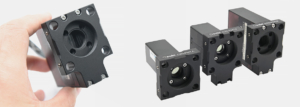
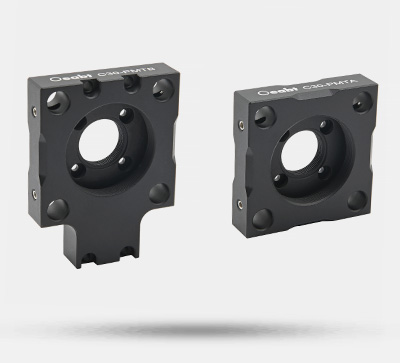
- Mounts photomultiplier tubes (PMTs) into cage systems
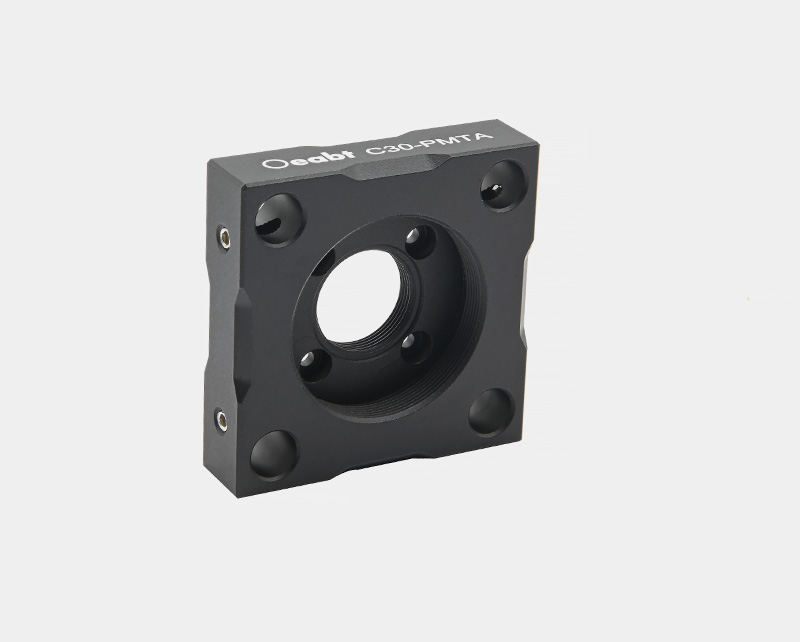
- Features SM1 and SM05 threaded holes for sleeve installation
- Countersunk holes for PMT connection, supplied with 4 pcs M2 cap head screws for mounting
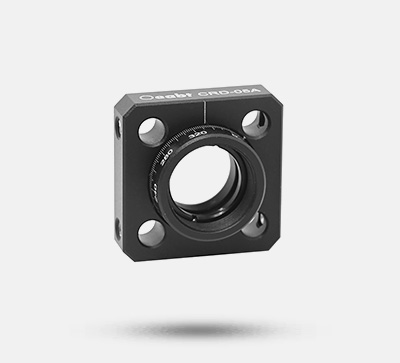
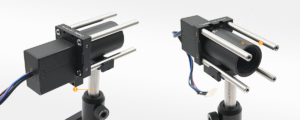
- Compatible with 30mm cage systems
- Adapts to the base sizes of various PMT end windows
Designed for adapting bare PMTs of different sizes and fixing hole positions as well as their matching bases, enabling their integration into the optical path of cage systems.
| Specifications | Details |
| Central Aperture | SM1 (1.035”-40) internal thread, SM05 (0.535”-40) internal thread |
| Compatible Cage System | 30mm cage system |
| Cage Spacing | 4 x Ø6.02mm, 30mm spacing |
| Material | 7075 Aluminum Alloy |
| Model | C30-PMTA | C30-PMTB |
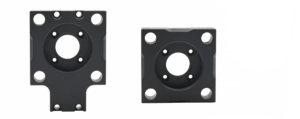
| Dimension | 40.0*40.0*10.0mm | 40.0*53.3*10.0mm |
| PMT End Window Mounting | 4 x M2 (countersunk holes), 14*14mm spacing | 4 x M2 (countersunk holes), 1414mm spacing;4 x M2 (countersunk holes), 11.649.3mm spacing |
| Weight | 30.1g | 34.5g |
Technical Description
(1) Two models are available. Align the PMT with the M2 countersunk holes on the cage plate and fix it with the supplied M2 cap head screws. C30-PMTA: Suitable for PMTs with mounting holes in a 1414mm square array. C30-PMTB: Provides two sets of M2 countersunk hole positions, compatible with PMT mounting in a 1414mm square array and an 11.6*49.3mm matrix.
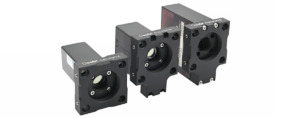
(2) The center integrates SM1 (1.035″-40) and SM05 (0.535″-40) internal threads, which can directly connect lens sleeves or filter assemblies of corresponding sizes. It firmly mounts PMT detectors of different sizes in the 30mm cage system, enabling precise alignment of the photodetection module with the optical path.
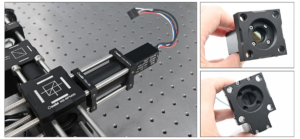
(3) C30-PMTA: Suitable for PMTs with mounting holes in a 1414mm square array. C30-PMTB: Compatible with PMT mounting in a 1414mm square array and an 11.6*49.3mm matrix.
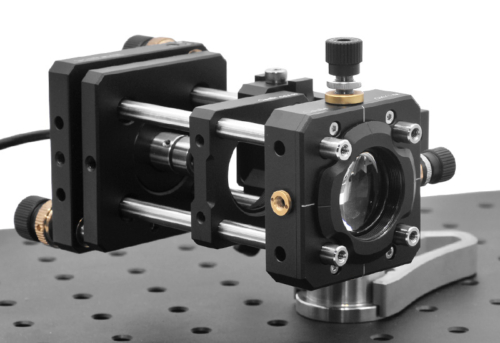
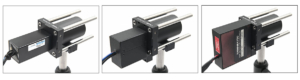
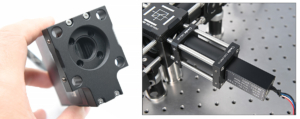
(4) Sleeves, filters and aperture assemblies are mounted via the central SM1 or SM05 threads. The adapter can be mounted horizontally or vertically to adapt to different experimental layouts.
Assembly
Application Examples